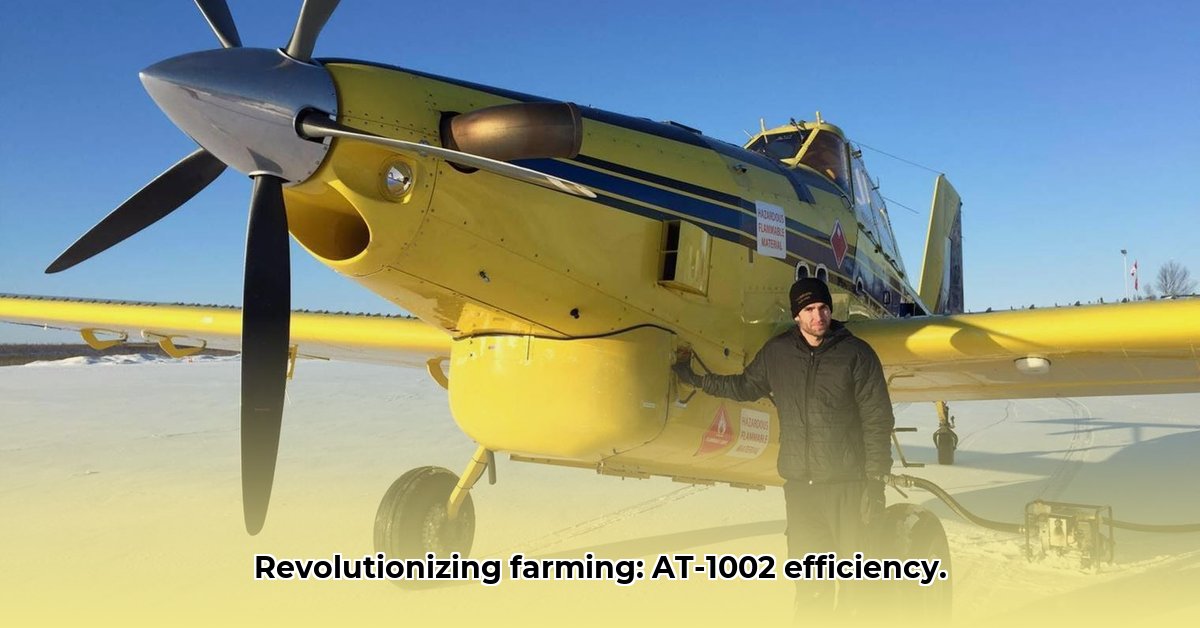
The Air Tractor AT-1002 represents a significant advancement in agricultural aviation, offering a powerful solution for large-scale farming operations. Its capabilities in efficient and precise application of fertilizers, pesticides, and seeds are transforming how farmers manage vast acreages, impacting both productivity and environmental sustainability. This article analyzes the AT-1002's role in modern agriculture, examining its operational advantages, cost-effectiveness, and environmental implications. For comparison, see information on the Air Tractor AT-400.
Understanding the AT-1002: Precision and Efficiency in Aerial Application
The AT-1002's design prioritizes speed and precision. Its large payload capacity allows for fewer passes over fields, minimizing disruption to crops and saving valuable time. This translates to significant gains in operational efficiency, particularly during crucial planting and treatment windows. But speed alone isn't the whole story; the plane's advanced technology facilitates precise application, ensuring that inputs are delivered effectively and with minimal waste. This targeted approach not only enhances crop health but also reduces the environmental impact associated with over-application.
Sustainability Assessment: A Complex Equation
The AT-1002's inherent efficiency contributes to environmental sustainability. Fewer field passes mean less fuel consumption per acre compared to ground-based methods. This directly reduces greenhouse gas emissions and the overall carbon footprint of farming operations. However, the fuel used, even with improved efficiency, does contribute to emissions. A thorough lifecycle assessment, encompassing production, operation, and eventual disposal, is needed to fully evaluate its overall environmental impact. Further research into alternative fuels for the AT-1002 is also crucial for its continued role in sustainable farming. How much can fuel efficiency be improved through technological advancements? This question determines the future environmental footprint of aircraft like the AT-1002.
Economic Considerations: Balancing Investment and ROI
The AT-1002 represents a substantial initial investment. However, the potential for long-term return on investment (ROI) is significant due to increased operational efficiency and reduced input costs. Precise application, leading to less wasted fertilizer and pesticides, directly contributes to cost savings. A detailed cost-benefit analysis, tailored to individual farming operations, crop types and field sizes, is essential to determine its economic viability in various contexts. What are the typical break-even points for AT-1002 investments in different agricultural settings? Such data would provide valuable financial insights for potential buyers.
Challenges and Limitations: Addressing Real-World Constraints
While offering immense potential, the AT-1002 faces several challenges. The high upfront cost is a significant entry barrier for many farmers. Specialized pilot training adds to the overall operational costs, requiring both financial investment and a commitment to specialized training programs. Addressing the environmental impact of fuel combustion remains a critical concern, demanding ongoing research into cleaner alternatives and more efficient systems. Furthermore, the infrastructure requirements, including suitable runways and maintenance facilities, might restrict adoption in certain regions. What innovative solutions can mitigate the limitations and broaden the accessibility of this technology? This remains a key question for future development.
Future Outlook: Technological Advancements and Sustainable Solutions
The agricultural aviation sector is constantly evolving, with significant potential for enhancing the AT-1002's sustainability profile. Research into hybrid and electric propulsion systems promises significant advancements in reducing the technology’s environmental footprint. Automation holds great promise in improving both efficiency and safety, reducing reliance on highly skilled pilots. These future developments will play a significant role in shaping the AT-1002's contribution to a more environmentally friendly and economically viable agricultural sector. How will the integration of AI and autonomous flight systems influence the costs and operational efficiency of the AT-1002? These technological innovations will greatly impact its future adoption across various contexts.
Conclusion: A Promising Technology in Need of Further Study
The Air Tractor AT-1002 showcases the potential for aerial application to enhance both farm efficiency and environmental sustainability. However, a comprehensive understanding of its long-term impact requires further research. Detailed lifecycle assessments, comprehensive economic analyses across various farming operations, and continued investigation into cleaner fuel sources are vital steps in defining the AT-1002's place in the future of sustainable agriculture. Only then can we fully assess its contribution to a more productive and eco-conscious farming industry.